
From Data to Decision: Why AI-Centered Enterprises Will Define the Future of Supply Chain


For years, supply chain leaders have invested heavily in becoming “data-driven.” Dashboards became richer, reports became faster, and data pipelines became more sophisticated. Yet despite all this progress, many organizations still struggle with the same core problem: decisions are slow, reactive, and often made too late to create real impact. The gap is not a lack of data. The gap is the inability to move from data to decision at the speed modern supply chains demand.
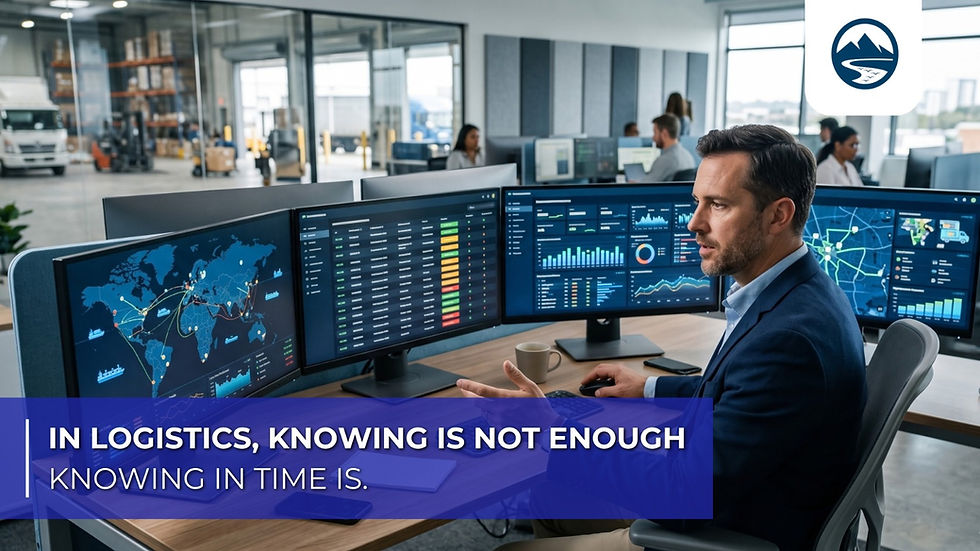
This challenge becomes even more pronounced in logistics and supply chain environments, where disruptions are constant, variables are interdependent, and outcomes change by the hour. Shipment delays, contract constraints, pricing volatility, regulatory risks, and customer SLAs all collide in real time. In this environment, data visibility alone is not a competitive advantage. Decision velocity is.
This is where the shift from being data-driven to becoming AI-centered begins.
In a recent The Summit Speaks podcast discussion with Dr. Ram Bala, a globally recognized expert in AI, analytics, and supply chain strategy, a powerful distinction emerged. Most companies today operate in a data-informed mode, where analytics describe what has already happened. AI-centered enterprises, by contrast, operate in a decision-guided mode, where intelligence actively helps leaders determine what to do next and how fast to act.
The traditional journey from data to decision has always been complex. Raw data must be extracted from ERP systems, transportation platforms, financial tools, and spreadsheets. It must then be cleaned, reconciled, interpreted, debated, and finally translated into action. In many organizations, this process takes hours or even days. By the time a decision is made, the operational reality has already changed. In supply chains, delayed decisions often carry a real cost: higher freight spend, missed SLAs, margin leakage, customer dissatisfaction, and firefighting that never truly ends.
Artificial intelligence fundamentally changes this equation by compressing the entire data-to-decision cycle. Large Language Models and agentic AI systems are now capable of understanding both structured data, such as shipment milestones or cost tables, and unstructured data, such as contracts, emails, policies, and operational notes. This matters because real business decisions are rarely driven by numbers alone. They are shaped by conversations, exceptions, legal clauses, and human judgment, most of which live in natural language.
AI-centered enterprises leverage this capability to move beyond siloed analytics. Instead of optimizing isolated functions like forecasting or routing in isolation, AI connects insights across operations, finance, legal, sales, and customer service. The result is not just better reporting, but contextual decision support that reflects the full complexity of the supply chain.
One of the most powerful ideas discussed was the concept of AI as a cognitive amplifier. Rather than replacing human decision-makers, AI enhances their ability to think, evaluate, and act. A task that once required eight hours of manual analysis can now be completed in one or two hours with AI support. More importantly, the time saved allows leaders to explore multiple scenarios instead of committing to a single path. In supply chain planning, this means stress-testing decisions against disruptions, demand shifts, or capacity constraints before they occur, rather than reacting after damage is done.
AI also plays a critical secondary role as a guardian layer. Even experienced professionals miss details under pressure, especially when decisions involve dozens of variables. AI systems operating in the background can flag inconsistencies, surface risks, or highlight overlooked constraints before a decision leads to costly consequences. This combination of amplification and protection is what transforms AI from a tool into a strategic advantage.
The implications for logistics and supply chain organizations are profound. Consider procurement and pricing, where negotiations are governed by thousands of contracts written in natural language. Historically, understanding what discounts were offered, what clauses apply, or what risks exist required manual review or institutional memory. AI now makes it possible to extract intelligence from those contracts instantly and use it to guide negotiations in real time. The same applies to operations, where disruptions like port congestion or canal closures demand rapid reallocation of capacity. AI-enabled systems can interpret the situation as described by humans and translate it into actionable recommendations within minutes.
This evolution aligns closely with the vision outlined in Ram Bala’s work, including his book The AI-Centered Enterprise, which emphasizes that true AI adoption is not about isolated use cases or experimental pilots. It is about embedding intelligence across the enterprise in a way that connects silos, accelerates collaboration, and aligns decisions with business priorities.
At SummitEdge, this philosophy is at the core of how we approach AI and analytics for supply chain organizations. We see firsthand that the most successful companies are not those with the most dashboards, but those that can act decisively with confidence. They understand that AI is not a future aspiration but a present-day necessity in an industry defined by volatility and speed.
The competitive reality is already clear. Organizations that use AI to compress the time from data to decision will outperform those that rely solely on human-driven analysis. Individuals and teams who leverage AI as a productivity amplifier will complete in hours what others take days to accomplish. This is not about technology replacing people. It is about technology enabling people to operate at a higher level.
The future of supply chain belongs to AI-centered enterprises. Enterprises where data flows freely, intelligence is contextual, and decisions are guided rather than delayed. In a world where disruption is constant, the ability to move faster than uncertainty is no longer optional. It is the defining advantage.
We help supply chain and logistics organizations eliminate manual reporting, connect siloed data, and embed AI-driven decision intelligence across operations, finance, and customer performance. If you’re ready to shift from static dashboards to real-time, decision-guided execution, our experts are here to help.
Let’s discuss your AI and analytics roadmap today.
Visit summitedge.com or reach out to our team to see how SummitEdge can help you become an AI-centered enterprise.


Comments