
The Logistics Data Problem Isn’t Data. It’s Timing.

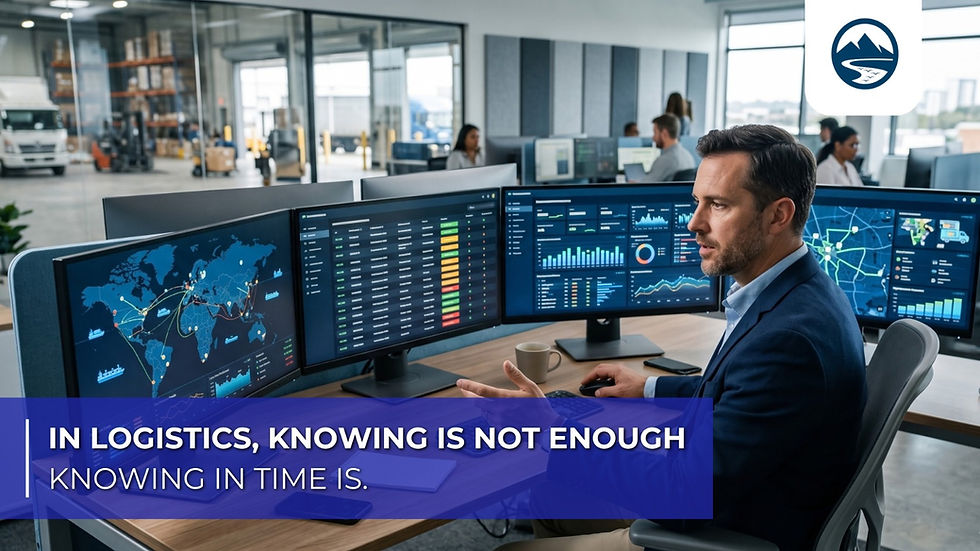
Logistics companies aren't short on data.
Shipment data. Customer data. Financial data. Warehouse data. Carrier data. SLA data. Margin data.
ERP, TMS, WMS, CRM, spreadsheets, carrier portals, customer platforms - more systems generating more information than ever.
The problem was never whether the data exists.
It's whether the right person sees the right insight at the right moment.
In logistics, timing is everything. A two-hour delay is manageable. The same delay, discovered two days later, is a missed delivery commitment, an angry customer, an SLA breach, detention and demurrage charges, and a team scrambling to explain what happened.
Most logistics organizations don't have a data problem. They have a timing problem.
The Cost of Knowing Too Late
Every day, teams pull data from operational systems, update spreadsheets, consolidate reports, and distribute performance summaries. On paper, that looks like visibility.
But there's a real difference between reporting what happened and knowing what needs attention right now.
A report can tell an operations manager which shipments were delayed yesterday, which customers hit SLA issues, which invoices are unbilled, where workloads are growing. By the time it lands on a desk, the window to act on any of it may already be closed.
At that point, the organization isn't managing the exception. It's managing the consequences of the exception.
This is a structural issue: operational, customer, and financial data lives across ERP, WMS, TMS, CRM, and spreadsheets - and reporting still leans on manual consolidation to pull it together.
Data Has a Shelf Life
Not all information carries the same value at every moment.
A shipment status at 9:00 AM can prevent a problem. The same status at 5:00 PM just explains why the customer is already on the phone.
Same risk, two timelines:
With real-time visibility:10:00 AM - risk detected. 10:15 AM - operations intervenes. 11:00 AM - shipment recovered. Customer never notices.
With delayed reporting:10:00 AM - risk exists, unseen. 2:00 PM - report generated. 4:00 PM - team reviews it. 5:00 PM - customer asks why the shipment is late.
The data existed in both scenarios. What differed was when the organization acted on it.
The Spreadsheet Isn't the Enemy
This isn't an argument against spreadsheets - they're flexible, familiar, and genuinely useful.
The problem starts when a spreadsheet becomes the operational intelligence layer for a growing logistics business: analysts extracting data from multiple systems, reconciling it by hand, building pivot tables, spotting exceptions by eye, formatting reports, sending them out, and waiting.
That's a reporting process. It isn't a real-time decision system.
And it doesn't scale. More shipments create more data. More data creates more reporting. More reporting creates more manual work. More manual work creates more delay.
Fragmented Systems Create a Visibility Gap
Few logistics organizations run on one system. A typical stack looks like:
ERP → financial and operational transactions
TMS → transportation activity
WMS → warehouse activity
CRM → customer and account information
Spreadsheets → local reporting and analysis
Each piece can work exactly as designed, and leadership can still struggle to answer one simple question: what needs my attention right now?
The individual systems usually aren't the problem. The missing unified layer connecting them is.
From Reporting to Exception Management
The shift that matters most in modern logistics intelligence: moving from "here's everything that happened" to "here's what needs attention."
Operations managers don't need to scan a thousand shipments every morning. They need to know which ones are at risk, which SLAs are close to breach, which exceptions need escalation, where workload is becoming unbalanced.
Signals should surface. Teams shouldn't have to go hunting for them.
Different Teams Need Different Answers
Traditional reporting hands everyone the same numbers. But a CFO and an operations manager aren't asking the same questions.
Leadership wants bottlenecks, underperforming branches, rising SLA risk.
Operations wants delayed shipments, at-risk milestones, where to put resources right now.
Finance wants margin leakage, what's unbilled, climbing cost-to-serve.
Sales & account management want to know which customers are having problems - before those customers call to tell them.
Same underlying systems. Different decision context. Intelligence has to be role-specific to be useful.
The Real Goal Isn't More Data
This is where a lot of digital transformation efforts go sideways: another dashboard, another integration, another data source - until teams have more dashboards than decisions.
The goal was never more information. It's better decisions from the information that already exists.
That means turning operational data into a simple chain: signal → context → action.
Signal: a shipment is approaching SLA breach.Context: the customer is high-priority and the delivery window closes today.Action: operations gets an alert and intervenes before the breach happens.
That's the line between analytics and operational intelligence.
What Changes When Intelligence Becomes Real-Time
The questions change.
"What happened yesterday?" becomes "What's happening right now?""Why did we miss the SLA?" becomes "Which shipments are likely to miss it?""Why did overtime spike?" becomes "Where is workload building before overtime is necessary?"
That's the move from reactive management to proactive control.
The Business Impact of Acting Earlier
Faster intelligence isn't about a nicer dashboard. It's about what earlier action makes possible. Organizations that made this shift have reported:
50–70% reductions in manual reporting workload
Earlier SLA threshold detection
Fewer escalation-driven workflows
Lower detention, demurrage, and penalty exposure
Reduced overtime during volume surges
The principle underneath it all: the earlier a team sees a problem, the more options it has to fix it.
Turning Existing Data Into Operational Intelligence
This is where Edge Insights fits — not as a replacement for ERP, TMS, WMS, or CRM, but as the layer above them that turns fragmented signals into one operational picture:
Real-time visibility - shipments, workloads, SLAs, and margins, live
Automated exception detection - risk surfaced against defined thresholds, not found by accident
Role-based intelligence - operations, finance, sales, and leadership each see what matters to them
AI-driven insights - pattern and risk detection beyond static dashboards
Standardized reporting - less manual effort on the reports teams already build
Proactive decision-making - catching risk while there's still time to act
The goal: make the data your organization already has useful at the moment it matters.
The Future Isn't More Reporting
The logistics companies that win the next decade won't be the ones with the most data. They'll be the ones that turn data into action fastest.
A delayed shipment isn't a data point - it's a decision window. An SLA isn't a metric - it's a threshold. A margin report isn't paperwork - it's a chance to catch leakage before it compounds.
The edge comes from shrinking the distance between something happening, someone knowing, and someone acting. The shorter that gap, the more predictable the operation.
The Bottom Line
Logistics organizations don't need another place to store data. They need a faster path from data to decision.
That's the timing problem. Edge Insights is built to close it.
If your team is still finding out about problems after they've already cost you something - worth a conversation.


Comments